Once Human in 2026: From Chaotic Launch to a Stabilized Survival Experience
Once Human's seasonal reset controversy almost killed character progression, but the studio's responsive fixes saved the co-op survival game's community.
Back in 2024, the post-apocalyptic survival game Once Human made its debut, instantly drawing players into a world ravaged by a mysterious extraterrestrial infection. This Starry Studio title blended sci-fi horror with cooperative survival mechanics, letting players build bases, scavenge for resources, and fight grotesque mutants born from non-living matter. The free-to-play model attracted a huge crowd, but the initial wave of enthusiasm soon collided with a mix of technical troubles and policy disputes.
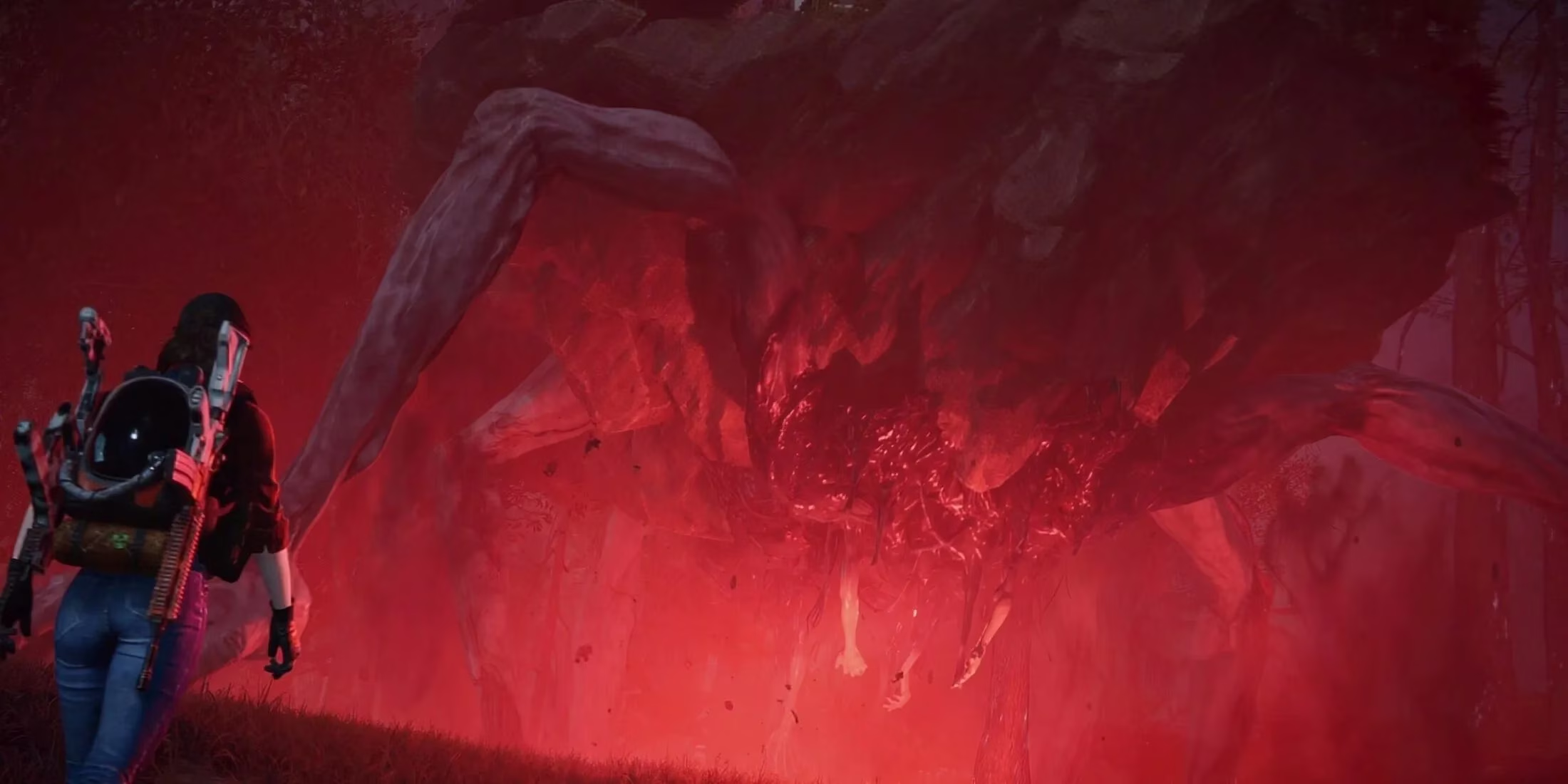
Steam reviews in those early days told a contradictory story. While many praised the game's atmosphere and creature design, a significant number of reviews pointed to deep frustrations. Server crashes became a semi-frequent occurrence during peak hours, leaving players staring at long queue screens. The demand clearly outpaced the server capacity, and Starry Studio scrambled to announce a roadmap that started with immediate hardware upgrades and the introduction of an invitation code system to help friends stay together on the same server.
Beyond the performance woes, two larger controversies brewed within the community. First, the third-party End User License Agreement (EULA) drew sharp criticism for its data collection practices. The document granted NetEase, the parent company, permission to harvest government identification numbers, demographic details, IP addresses, and more. Many in the player base called it a gross overreach, though the developers quickly clarified that sensitive data like government IDs were only collected in jurisdictions where required by law, such as South Korea, and would be deleted immediately after verification. Over time, the conversation shifted—some veterans noted that the EULA's language was simply a more transparent version of what most game publishers quietly demand. Still, the episode highlighted growing concerns about data security across the gaming industry.
Second, a wave of confusion hit the player base when Starry Studio detailed its plan for seasonal resets. Every six weeks, all character progress would revert to level 1. In a genre where grinding for rare blueprints and gear is the core loop, this felt like a betrayal of player investment. The community backlash was immediate and loud. However, unlike many developers who dig in during such storms, Starry Studio showed impressive responsiveness. They quickly confirmed that critical progression elements—blueprints, recipes, and certain cosmetic items—would carry over between seasons. They further patched the game so that purchased cosmetics would apply account-wide rather than per character, addressing a painful double-dipping problem. The studio even left the door open to scrapping the seasonal reset fully or offering alternative servers with more content inheritance for players who prefer long-term accumulation.
Fast forward to 2026, and Once Human stands as a testament to steady post-launch refinement. The server infrastructure has matured significantly. Queue times are now a rarity except during major content drops, and crash incidents have dropped to near zero thanks to continuous optimization and cloud scaling solutions implemented over the past two years. The invitation code system evolved into a full-fledged guild migration tool, allowing entire communities to relocate seamlessly when new servers open.
The EULA concerns, while never entirely forgotten, have largely faded from everyday discussion. Starry Studio now publishes a plain-language privacy summary alongside the legal text, and an in-game dashboard lets players see exactly what data is being collected at any time. This transparency push, born from the 2024 backlash, became a selling point that other live-service games have started to emulate.
Perhaps the most dramatic shift has occurred around the seasonal structure. Listening to player feedback, the studio replaced the rigid six-week full reset with a hybrid model. Challenge seasons still bring fresh mutations, map events, and limited-time rewards, but players can now choose to participate in an “Eternal” server type where base progress, character levels, and stash contents persist indefinitely. Seasonal characters can also be merged into the Eternal realm at the end of each cycle, carrying over a curated selection of seasonal currencies and unique blueprints. This dual-track system managed to satisfy both hardcore fans who enjoy fresh starts and builders who despise losing their creations.
Content updates in 2026 have pushed deeper into the cosmic horror themes that set Once Human apart. Recent patches introduced awakened hive-mind structures that can corrupt player-built fortifications, forcing cooperative defense events that require coordinated strategy. New weapon archetypes leverage the infection itself, letting players harness limited-time mutant abilities at the risk of temporary debuffs. The crafting pool has expanded to include bio-organic furnishings, moving beyond the typical scrap-metal aesthetic into something genuinely otherworldly.
The community has grown into a vibrant but guarded culture. Veteran players still recall the rocky launch and often advise newcomers to read the privacy settings before logging in. Yet the general sentiment in forums and reviews has tilted firmly positive. Steam ratings have climbed from “Mixed” to “Very Positive” over the two-year journey, a rare recovery arc in the free-to-play market. The development team’s habit of holding bi-weekly developer streams and maintaining a public issue tracker has built a level of trust that no amount of marketing could have bought in 2024.
Of course, not every edge has been smoothed. Some regions still face occasional routing lag, and competitive players debate the balance of mutated weapons in PvP zones. The cosmetic shop, while fairer than before, still draws fire for its pricing tiers. Yet these are the typical growing pains of a live-service game, not existential threats. For a title that once seemed poised to drown in its own controversies, Once Human in 2026 delivers a compelling survival sandbox that has learned from its mistakes and keeps evolving at a pace its player base appreciates.
As the game enters its third year, Starry Studio is teasing a major narrative expansion that will reveal the origins of the stardust infection. Leaked footage suggests massive underground biomes and a faction system that lets players align with different survivor philosophies. Whether the studio can execute this ambition without repeating past missteps remains to be seen, but the foundation they’ve rebuilt brick by brick suggests that Once Human’s future is far brighter than its troubled beginnings ever promised.
Leave a Reply
Comments