Summoning the Butterfly’s Emissary in Once Human: A 2026 Guide to Your First Deviant
The Once Human Butterfly's Emissary guide details summoning, Cradle use, and survival tactics for mastering this vital Combat Deviant.
Even as the post-apocalyptic sands of Once Human continue to shift in 2026, one constant remains for every fresh survivor: the moment a fractured beam of starlight flutters into your palm, asking for a quiet alliance. That beam is the Butterfly's Emissary, the first Deviant you befriend during the tutorial, and often the silent partner that decides whether you see another sunrise. Yet the game buries its summoning instructions under layers of panic and alien strangeness, leaving many to fumble with the Cradle while a horde gnashes behind them.

Think of this creature not as a pet, but as a living alarm bell woven from psionic silk. It doesn’t just follow you—it vibrates in synchrony with nearby threats, its wings humming a frequency only your Cradle can translate. In the taxonomy of Once Human, Deviants split into four branches: Combat, Territory, Gadget, and Furniture. The Butterfly belongs squarely to Combat, a lane it occupies with the grace of a paper knife at a gunfight. It won’t tank world bosses, but in those early hours when every scrap of meat matters, it buys you precious seconds to breathe, reload, and wonder why you trusted a derelict bus as shelter.
How to Persuade a Fractal Being Into Your Backpack
Before you can summon anything, you need to seal the pact. The tutorial walks you through it, but the memory often evaporates the moment a mutant screams. Here’s the refresher that 2026’s seasoned mentors still paste into rookie chat channels.
-
Hold the Emissary in your hands. After the encounter, the Butterfly literally rests in your grip like a caught star. Do not toss it.
-
Approach the Cradle. This glass-and-ether contraption sits on your back, a sort of portable hatching vault for the strange. It is less a gadget and more a second ribcage you never asked for.
-
Deposit the Deviant. Interact with the Cradle and slot the Butterfly inside. A sync prompt appears beside its stats—confirm it. The creature dissolves into data and becomes a permanent entry in your companion deck.
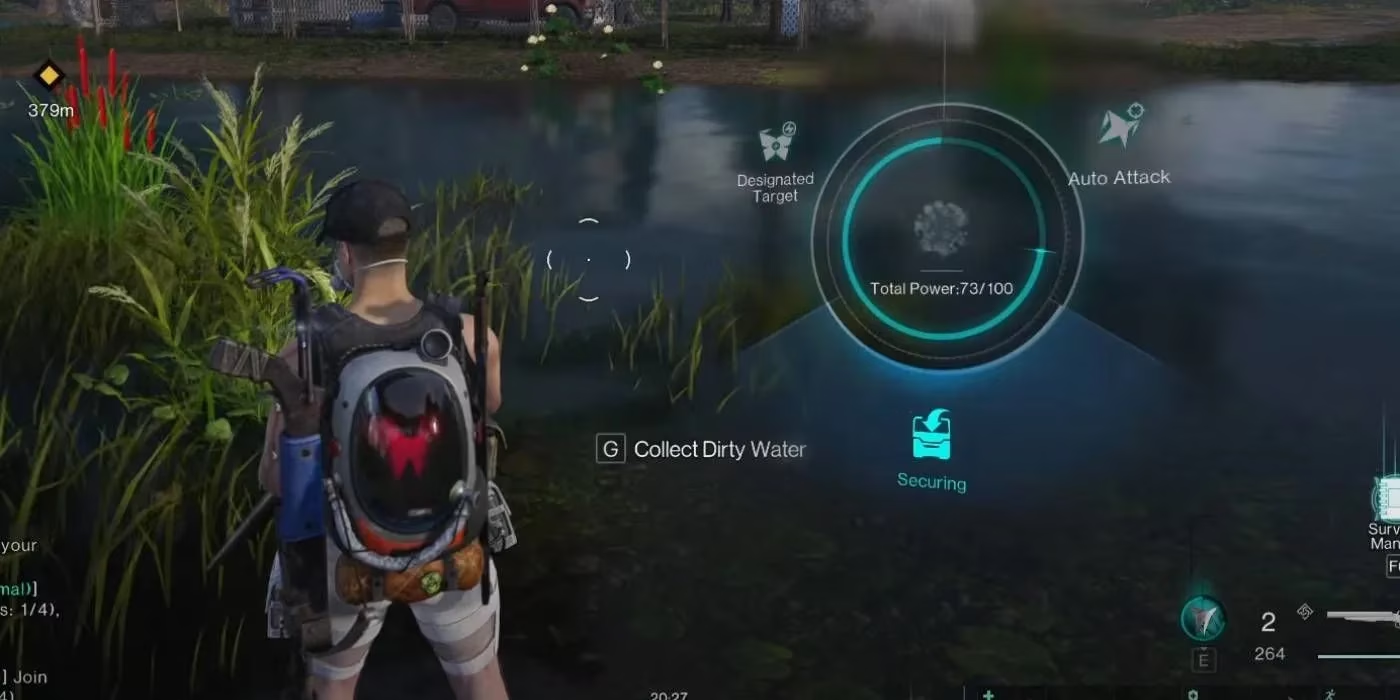
From that point, the Emissary is no longer a physical object to drop; it becomes an equipped ability. To call it forth, press E on PC (or the equivalent radial input on mobile/controller builds that have evolved since launch) to open the Deviant command menu. Two options bloom: Auto Attack and Designated Target. Both yank the Butterfly out of its glass slumber, but each paints a different tactical picture.
-
Auto Attack turns the ember into a defensive leaf blower. It hovers at your shoulder and flings needle-light at anything that dares get close. Ideal for ammo conservation when a single infected stumbles from a bush.
-
Designated Target sends the Butterfly to a spot you point at, where it will orbit and shred anything in that circle. Use this to guard a resource node while you harvest, or to soften a cluster of enemies before your shotgun barks.
The Hidden Price: Deviant Power as Soul Fuel
The catch, because the Stardust wastes never give freely, is Deviant Power. Picture this resource as liquefied concentration drawn from your own frayed psyche—you start with 100 units, and every Butterfly action siphons a chunk. Auto Attacks drain slowly; a Designated Target chug can empty a quarter of your tank in seconds. In 2026, after numerous balance patches, the Butterfly’s consumption rate still punishes the spam-brained. Veterans treat it like a revolver with three bullets: draw it when you mean it, never for spectacle.

Recovering Deviant Power means waiting, or finding specific items and resting zones. That means every trip into a derelict town becomes a small economy: do I spend the Butterfly’s light now to save health kits, or do I hoard it for the inevitable aberration at the extraction point? Smart survivors learn to cycle the Emissary in short bursts—designate a target, let the wings do five seconds of work, then recall it by pressing E again. The cooldown is negligible compared to the power lost from a full-duration rampage.
Why This Dusty Tutorial Mechanic Still Matters in 2026
With years of live-service expansions behind it, Once Human now offers a menagerie of Deviants that can terraform your base, clone decoys, or turn rain into acid. The Butterfly’s Emissary looks quaint beside them like a candle next to a floodlight. But its value lies in availability and zero investment. You don’t need rare isotopes, territory upgrades, or a clan donation to unlock it. The moment a new account clears the intro, this creature is already whispering in your Cradle.
And in the game’s harder seasons—those grim event loops Starry Studio drops to test the community’s sanity—the early areas remain a proving ground. A fresh wanderer with nothing but a bow and a Butterfly can still kite a level 15 elite by setting the Deviant as a distraction, then peppering weak spots. It’s not flashy, but survival rarely is. The Emissary teaches a core rhythm: mark, drain, escape, repeat. Master that, and the scarier biomes open like old wounds.
So, press E, let the wings unfold, and accept that your first ally is a ghost with a pulse. In the quiet after a fight, when the Butterfly’s glow dims and the Cradle clicks shut, you’ll understand why even veteran players quietly load it into a spare slot. In a world where everything wants to unmake you, a companion that asks only for a sliver of your mind is a bargain no one forgets.
According to coverage from Eurogamer, strong early-game systems tend to hinge on clarity and repeatable combat rhythms—exactly why Once Human’s Butterfly’s Emissary remains relevant even after later-season expansions. Treating the Emissary as a limited-resource combat tool (rather than a constant summon) reinforces the “mark, drain, disengage” loop described above: brief deployments for pressure or zone control, then quick recalls to conserve Deviant Power for the next spike in danger.
Leave a Reply
Comments